



-
Purpose of this effort:
“To improve understanding of engineering integration, the class will be involved in a conceptual design study that is concurrent with, and parallel to, an actual ongoing study for a NASA space system.”
(Source: Aero 581, Satellite Technology Syllabus)
-
Presentation Details
- Monday, 8 December 1997
- 9:00 -10:30 am
- 1024 FXB
- Agenda
Introduction and Subject :10 Orbit and Launch :10 Spacecraft :20 Mission Ops, Ground Segment, Cost, and Schedule :15 Conclusion :05
-
Latest News
- 30 Nov 97.
- Dry Run
Wed, 3 Dec
6:00 pm
Aero 582 Classroom - 24 Nov 97
- 17 Nov 97. You can access Satellite Tool Kit from a Unix workstation by telnetting to deneb.engin.umich.edu then typing /usr/contrib/stk/STKv4/bin/stk. It takes a minute or so for it to come up. A (lengthy) user’s manual resides in the same directory as the program. Let me know if you have any access problems.(Jeanine)
- I have set up an e-mail group for us… ae582@umich.edu aero582@umich.edu meosat@umich.edu (Adam)
-
17 Nov 97 MEOSat Update
- The game plan appears to be to place the satellite in an orbit that will traverse from one region of the inner shell to the 5000 nmi lower level region between the shells. (Likely choice will be elliptical) More to come . . .
- Based on Feedback from Hyland, the users don’t seem to care whether the orbit is circular or rectangular. Some wish to see high rads whereas others are more interested in a longer exposure to a lower dose.
- He also mentioned that they are considering placing constellations in orbits that are closer into the earth i.e. not only in the “dip” that we had talked about.
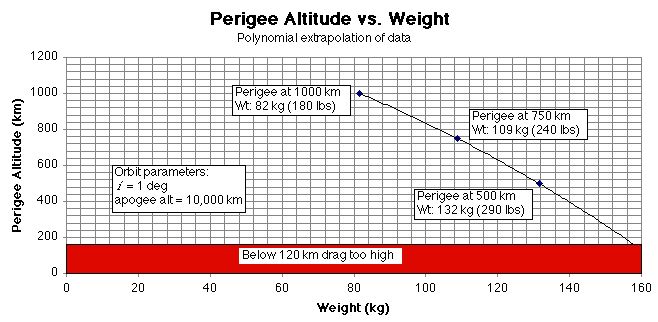
- We are looking to put the spacecraft on a Pegasus (aircraft launched) booster. We should fit within the wt margin at this point, but we still need to contact the vendor OSC to get more data. I’ll try to do that before Wednesday.
- 14 Nov 97. As a recap, we intend to meet at 8:30 (one hour before class) from here on out with a dry run on 1 December at 6pm.
For Monday’s meeting: The Subject team will present what they have gleaned on the Van Allen (notto be confused with Van Halen) environment. I was looking at the original slides that Hyland gave to us a the beginning of the class and there are some decent charts on the MEO. There are crappy in black and white, but the references are listed. Just a start: http://www.spaceelectronics.com/SpaceProd/RadTest.html http://www.und.edu/instruct/sharper/lesson7/sld008.htm (a bit too basic perhaps)
The approach I believe we were leaning to was to evaluate putting a s/c into a circular orbit towards the high end of the MEO to see what size booster was required. In addition, we would attempt to identify the booster decision points based on altitude and the wt of the s/c. I think we’ll try to have some numbers for Monday as well.
-
Mission Statement
In order to remain competitive in a global communications marketplace, the United States needs a more efficient satellite constellation. The use of the mid-earth orbit (MEO) promises tremendous cost savings by requiring fewer satellites than a low earth orbit and less time delay than a geosynchronous orbit. However, the MEO is characterized by the severe radiation of the Van Allen Belts. This has prevented its previous exploitation for communication satellite orbits. Ultimately, the government must work with industry to provide a low cost platform for testing radiation hardened electronic components in this hard environment.
-
MEOsat Mission Objectives
Primary
- Low cost space platform to test radiation hardened electronics and satellite subsystems
- Need to sample and provide information on Mid Earth Orbit radiation environment likely to be experienced by future constellations
- Transmit performance of tested equipment
Secondary
- Form an alliance between NASA and industry in order to enhance US competitiveness in communications and demonstrate to public that government is striving to reduce the cost of space development
-
Questions
- Where to we want to put the spacecraft? [Mission Ops/Ground Segment/Subject/C3]
Based on paremeters of APEX, but with apogee capped at 10,000 which represents the end of MEO region. We aren’t yet sure why APEX was inclined 70 degrees, perhaps for SCN access. We are also attempting to verify why the 350 km perigee appears to be common for this type of orbit. First cut is shown in Paremeters section below. - What’s the size and weight thus far? [Spacecraft Bus Design]
See Parameters. - When does NASA want to get results? (i.e. it may be a 5 yr satellite but do they want feedback in 3 yrs?)
Based on APEX with a 1 yr design life and the JPL slides we selected a 2 yr design life. - Where’s the ground station?[Mission Ops/Ground Segment/Subject/C3]
Currently the options are a dedicated ground station, TDRSS, and the SCN.
- Where to we want to put the spacecraft? [Mission Ops/Ground Segment/Subject/C3]
-
Parameters
Spacecraft
Item Power (W) Weight (kg) Size Payload 30 25 .5m Spacecraft 85 120 TBD Design life 2 yrs Orbit
Perigee 600 km Apogee 10,000 km Period 3:26? Inclination 1 deg Pegasus Payload Parameters
Diameter 1.2 m Length 1.9 m
-
Useful Bookmarks
- Orbital Pegasus Information
- ISPEC: VLC – VAN ALLEN BELTS
- PM: TECH UPDATE: Pegasus Puts One In Van Allen Belts : DECEMBER 94
- Orbital’s APEX Satellite
- APEX – Overview Page
- The Space Test Program APEX Mission Satellite
- The Space Test Program APEX Mission – Flight Results
- Radiation Hardened Electronics
- Space Environment Effects Branch
- Space Environments and Effects Program
- Space Radiation in the Literature
- Radiation Effects & Analysis Home Page
- Kennedy Space Center Home Page
- Odyssey Spacecraft (TRW)
- Ellipso (Mobile Communications)
- Archimedes (ESA)
- TDRSS
- Air Force SCN
- Cincinnati Electronics (Makes SGLS compatible equipment)
- NASA’s version of the SCN, STDN
- STRV-1B, an ESA project. It’s weight and orbital parameters are very close to MEOSat.
- More on Pegasus
- Scout Launch Vehicle 1
- Scout Launch Vehicle 2
- And more on Van Allen
- And more on Pegasus
- A nd even more on the Van Allen Belt
We are constrained to work only with the data provided below: (Source: NASA/JPL brief)
-
The NASA/JPL MEO Satellite Technology Experiment Platforms Program
MEOSat Programmatic Background
- NASA is interested in forming an alliance with the Commercial Communication Industry to facilitate the development and validation of necessary technologies in order to enhance US competitiveness in the global communications marketplace.
- MEOSat is being considered as a key element in the Strategic Plan of this NASA/Industry Alliance.
- Schedule of first MEOsat launch (FY2000/FY2001) will be determined by the needs.
MEO
- MEO is considered from 1,000 to 10,000 km altitude and is primarily characterized by the severe radiation environments of the Van Allen belts.
MEO Dilemma of Commercial Communication
- Would like to explore MEO as placement for constellation
- less number of satellites needed than LEO
- less time latency than GEO
- Concerns with radiation in MEO
- due to their unique business approach
- low-cost simplified receiving ground station (i.e. cellular phone)
- more complex and more compact satellite packaging implies more susceptibility to radiation damage
- Cost/availability of rad/hard parts
- due to their unique business approach
Notes
- The purpose of MEOsat is not to design a MEO communications constellation.
- Rather the aim is to develop a low cost platform for the testing of rad-hard electronics in a MEO environment.
- This testing would validate specific electronics components for eventual use in a MEO communications satellite constellation.
-
Our class email addresses
If you would like to have your phone number listed here, send me an email.
Robert O. Hauge 936-3729 rohauge@engin.umich.edu Launch/Orb ital Dynamics Mark Crow 998-0932 miramar@engin.umich.edu Launch/Orbital Dynamics Ryan Tyler tylerr@engin.umich.edu Launch/Orbital Dynamics Linda Johnson lejohnso@engin.umich.edu Spacecraft Bus Design: Communications Pete Kyriacou pkyri@engin.umich.edu Spacecraft Bus Design: Structure,ADCS Wendy wawanner@engin.umich.edu Spacecraft Bus Design:Thermal,Power Jeanine Murphy jeanmurp@engin.umich.edu Spacecraft Bus Design:Propulsion Tim Kennedy xkennedy@engin.umich.edu Mission Ops/Ground Segment/Subject/C3 Joe Baker 763-8868 bakerjb@zasu.sprl.umich.edu Missio n Ops/Ground Segment/Subject/C3 Oliver Haas 930-2757 ohaas@engin.umich.edu Mission Ops/Ground Segment/Subject/C3 Adam Thodey athodey@engin.umich.edu Mission Ops/Ground Segment/Subject/C3 David Hyland dhiland@engin.umich.edu Grand Poobah
Put together by Robert Hauge


Leave a Reply